Visual Testing (VT)
Develop the knowledge used to perform systematic visual inspections of components, welds, and structures. Visual testing is the most widely used inspection method and forms the foundation of many nondestructive testing programs across industry.
Why Take This Course?
Nondestructive testing (NDT) training prepares technicians, inspectors, and engineers with the knowledge needed to inspect critical components without causing damage. These courses are designed to support career advancement across industries such as oil & gas, aerospace, manufacturing, energy, and infrastructure while helping students build the training hours required for employer-based certification programs.
Flexible
Study at your own pace with 24/7 access to course materials. No travel expenses or time off work required—complete your training on your schedule, from anywhere.
Industry-Relevant Training
Our courses are designed for working professionals and may be used toward continuing education or recertification requirements. Training hours may qualify for recertification or professional development units through organizations such as API, AWS, and ASNT, depending on the certifying body’s requirements.
Learn From Experts
Professionally developed courses created and reviewed by field experts with decades of hands-on experience. Access instructor support whenever you need guidance throughout your training.
What You'll Learn
Your learning journey is tracked through our Learning Management System (LMS), allowing you to revisit any lesson as many times as needed during your enrollment. Each module develops your visual inspection capabilities from foundational concepts to professional-level defect recognition:
- Introduction to Visual Inspection – Understand VT’s critical role as the primary NDT method
- Physics and Fundamentals of Visual Inspection – Master light behavior, surface conditions, and visual acuity
- Visual Inspection Techniques – Apply direct, remote, and translucent inspection methods
- Basic Visual Inspection Equipment – Operate magnifiers, mirrors, borescopes, and measurement tools
- Visual Inspection of Welds – Identify porosity, cracks, undercut, and weld profile defects
- Visual Inspection of Castings and Wrought Products – Recognize surface irregularities and manufacturing defects
- Visual Inspection Procedures – Develop systematic inspection protocols and documentation practices
- Elements of Vision – Understand human visual perception, color recognition, and inspection limitations
- Elements of Lighting – Control illumination intensity, angle, and contrast for optimal defect detection
- Optics – Apply principles of magnification, focal length, and optical instruments
- Advanced Visual Inspection Equipment – Utilize videoscopes, fiberscopes, and digital imaging systems
- Service-Induced Discontinuities – Detect corrosion, wear, fatigue cracks, and in-service damage
- Evaluation – Apply acceptance criteria and make accurate accept/reject decisions
- Codes, Standards, and Specifications – Interpret ASME, AWS, ASTM, and API visual inspection requirements
Upon completion, you’ll be qualified to perform comprehensive visual inspections across welding, manufacturing, construction, and maintenance applications in accordance with industry codes and standards.
Required Textbook Purchase
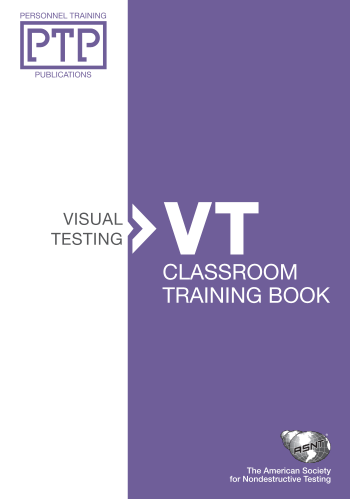
To meet certification and regulatory requirements, all students are required to purchase the ASNT Visual Testing Classroom Training Book directly from ASNT. This textbook is an essential resource and is necessary for successful completion of the course.
Students may choose between a physical copy or a digital edition, allowing them to begin their studies right away in whichever format best suits their needs.
Please note: due to ASNT’s copyright protections on digital materials, the National Inspection Academy cannot facilitate the purchase on your behalf. All orders must be made directly through ASNT.
Training Certificate
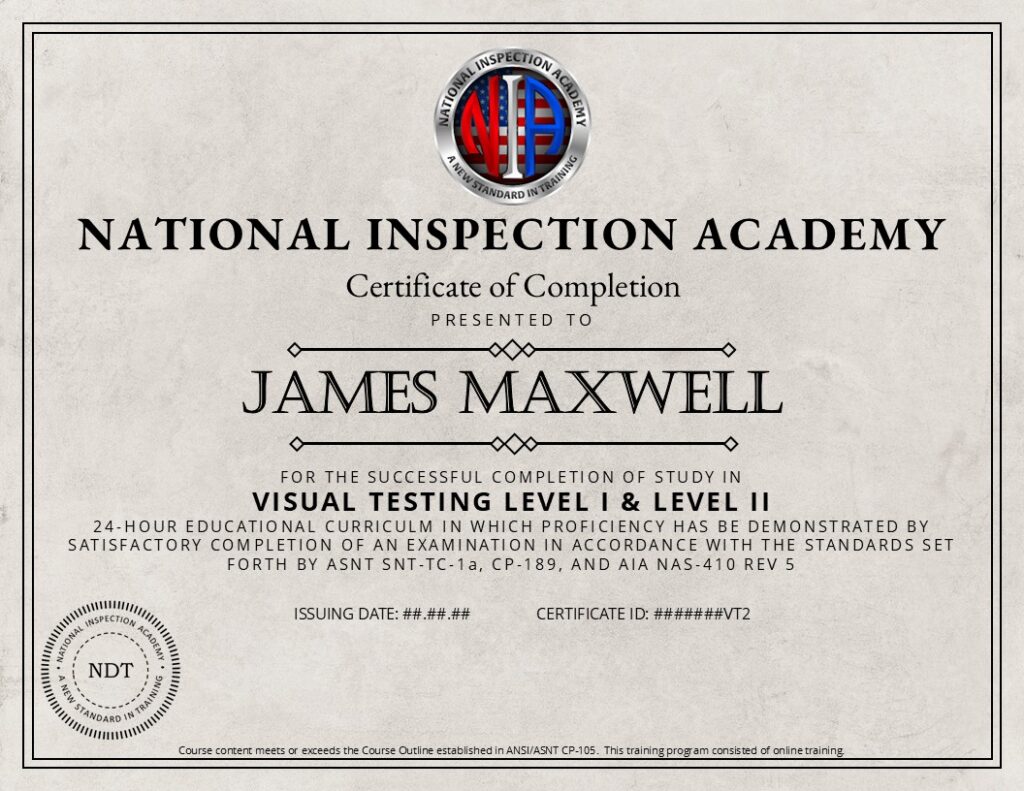
Upon successful completion of this course, students will receive a National Inspection Academy Certificate of Completion documenting the required training hours and successful examination in accordance with the guidelines outlined in ASNT SNT-TC-1A, CP-189, NAS-410, and the course outline requirements of ANSI/ASNT CP-105.